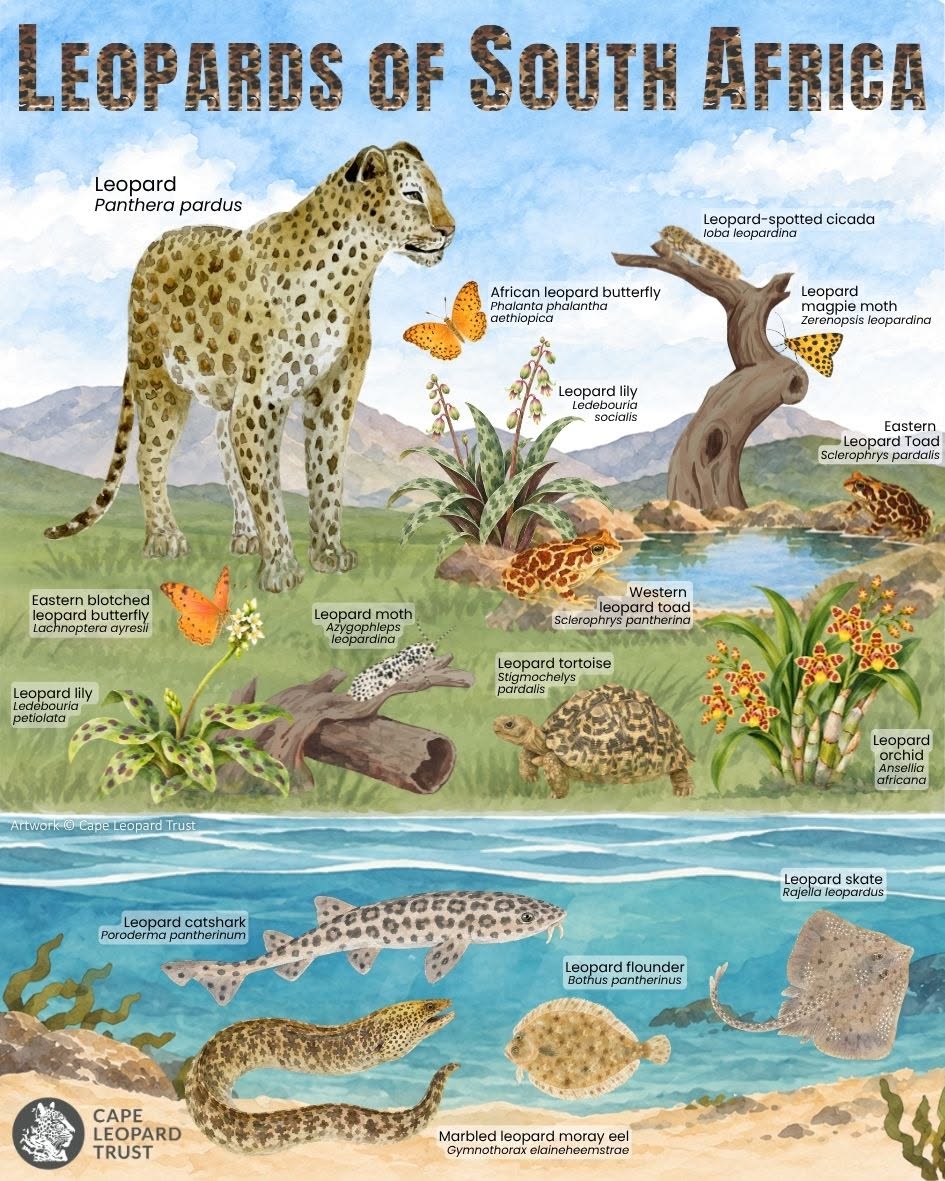
What comes to mind when you hear the word ‘leopard’? 🐆 The obvious answer would probably be that famous feline, 𝘗𝘢𝘯𝘵𝘩𝘦𝘳𝘢 𝘱𝘢𝘳𝘥𝘶𝘴. But did you know that South Africa is home to a whole variety of ‘leopards’? From plants and insects to amphibians, reptiles and marine life, ‘leopards’ can be spotted across the tree of life – all named for their spotted resemblance to the iconic big cat.
Spots (or more accurately rosettes) may be some of the prettiest patterns in nature, but these markings aren’t just for show. Across the natural world, spotted and mottled patterns can serve all sorts of purposes:
👀 For camouflage: spots can break up an animal’s outline and help it disappear into dappled or patterned surroundings – whether that’s vegetation on land or a rocky seafloor. ⚠️ For warning and deception: some spots do the opposite – standing out to warn predators or mimic danger. Bold patterns can confuse, deceive, or deter. 💘 For recognition and communication: patterns can also play a role in recognising members of the same species or attracting mates. 🌿 And plants get in on it too: mottled leaves and spotted flowers arise from patterns in pigmentation and development. These can help manage sunlight, deter herbivores, or attract pollinators.
✨ Different species, different environments, different challenges, same solution: a spot-tacular adaptation to survive and thrive!
At the Cape Leopard Trust, leopards (the feline kind 😉) may be at the heart of what we do, but they are just one piece in South Africa’s intricate biodiversity puzzle. Conserving leopards means understanding and protecting all the creatures they share the landscape with. Conservation is about protecting the entire web of life – not just the iconic species 🐆🌍
How many of these ‘leopards’ did you know existed? And when it comes to spots, who do you think wears it best? 👇
Artwork ©Cape Leopard Trust [designed with ProCreate and Canva Pro by a human, no AI involved]
#CapeLeopardTrust #LeopardsOfSouthAfrica #SpottedInSouthAfrica #WildllifeWednesday